
Fine Arts Paris 2026: beneath the nave of the Grand Palais, the object takes centre stage
Until 23 September, around a hundred galleries occupy the nave of the Grand Palais. With Charles Zana’s scenography, a preview of the Musée du Grand Siècle and Sèvres porcelain painted by Fabienne Verdier, the 2026 edition gives pride of place to furniture, objects and craftsmanship.
Reading time: 5 minutes
On Friday 18 September, the day before the fair opened to the public, the jury of the CPGA–Fine Arts Paris Prize gave its verdict. It did not choose one of the grand stands in the nave, but ten square metres: those of Haesaerts-le Grelle, a Brussels gallery specialising in 19th- and 20th-century decorative arts and in Gustave Serrurier-Bovy (1858–1910), the Liège architect-decorator who was one of the founders of Art Nouveau in Belgium. On the fair’s website, the gallery announces a pair of chairs from the Saint-Saëns series, circa 1905: padauk, Loetz glass panels, brass, original upholstery, provenance Colleye collection.
The signal matters. On a jury that includes Olivier Gabet, director of the Louvre’s Department of Decorative Arts, it was a furniture stand, run by two restorer-dealers and housed in the section reserved for young dealers, that won. It sums up rather well what this edition has to show.
A fair with a new name, new dates and a new president
Fine Arts Paris was founded in 2017 by the organisers of the Salon du Dessin. In 2022 it merged with the Biennale des Antiquaires and became FAB Paris. Long held at the end of November, it moved to the second half of September in 2025 in order, as Le Journal des Arts explained at the time, to fit the rhythm of the international market. In 2026 it returns to its original name, settles permanently at the Grand Palais and gains a new president, the dealer Xavier Eeckhout, a specialist in animalier sculpture.
The principle is unchanged: a generalist fair, from antiquity to contemporary creation, spanning some twenty specialities. For anyone interested in interiors, the appeal lies less in the numbers than in the neighbours. Within a few metres one moves from the 18th-century French furniture of Steinitz or Galerie Léage to the antique silver of newcomer Philippe d’Arschot from Belgium, then to an Aubusson tapestry after Le Corbusier woven by the Ateliers Pinton, announced by Galerie Hadjer, or to the ceramics of Karen Swami. This exercise in comparing periods and materials is the real reason to come.
Three ‘villages’ designed by Charles Zana
The scenography was entrusted to the Parisian architect-decorator Charles Zana. He has divided the nave into three ‘villages’ linked by avenues and punctuated by squares, offering, in his words, ‘an almost urban stroll’ in which works are discovered on foot, as in a neighbourhood. Interior architects will note the approach: it treats the fair as a city plan rather than a grid of stands, and creates breathing space beneath a glass roof whose scale easily overwhelms whatever is placed under it.
The fair also says it wants to honour decorators. Fifteen of them have been invited to pick their favourite pieces among the exhibitors: Tristan Auer, Kelly Boukobza, Victor Cadène, Cordelia de Castellane, Timothy Corrigan, François-Joseph Graf, Jacques Grange, Constance Guisset, Edgar Jayet, Thierry Lemaire, Jessica Mille, Chahan Minassian, Juan Pablo Molyneux, Jean-Michel Wilmotte and Charles Zana himself. The VIP lounge has been designed by Studio Andrée Putman.
A preview of the Grand Siècle
Guest of honour, the Musée du Grand Siècle will not open until 2028, in the former royal barracks at Saint-Cloud. Led since 2019 by the Hauts-de-Seine département and born of the donation of Pierre Rosenberg, honorary president of the Louvre, it is conceived as a museum of civilisation devoted to the years 1590–1720. At the Grand Palais it offers a glimpse of its future permanent galleries in a display designed by François-Joseph Graf: paintings, sculpture, furniture, precious objects and everyday things.
Among the pieces from its collections highlighted by the fair, two will catch the eye of decorative-arts enthusiasts: a Boulle marquetry writing box attributed to Alexandre-Jean Oppenordt, circa 1710, in tortoiseshell, brass and gilt bronze; and a casket by Jean Armand, circa 1655, decorated with grotesques in cedar, ebony, tortoiseshell, mother-of-pearl and ivory. Among the paintings, an Allegory of Good Government by Laurent de La Hyre, circa 1652.
Sèvres, cobalt and the hand of Fabienne Verdier
On stand C26, that of AXA, the fair’s official partner, the Manufacture nationale de Sèvres shows for the first time more than a hundred pieces made with the painter Fabienne Verdier. Two supports were chosen: the plates of the Diane service and a series of vases designed by Pierre Charpin. The artist worked for a year with the ground-laying workshop, which masters high-fire colours, fired at very high temperature together with the glaze. Cobalt, the origin of the famous Sèvres blue, is applied in three layers with a wide, soft badger brush.
Accustomed to very large formats, Fabienne Verdier had to bring her gesture down to the circular surface of a plate, a format close to the tondo. A note for the reader: this is a presentation backed by a partner of the fair, described here from the material it has released.
Nouveaux Horizons: eleven stands to watch
Another novelty, the Nouveaux Horizons section brings together eleven stands of around 10 m², reserved for dealers who are starting out or have never shown at a fair of this scale. Old master drawings, autographs, Asian art, silver, antique textiles: each has its speciality. Many work from an apartment or online and come here for the face-to-face encounter with collectors. The section includes the CPGA Prize winner, as well as Villa Rosemaine, AEON, Dedrie Gallery and Le Manuscrit Français. For a collector who is just beginning, it is probably where conversation starts most easily.
The jury also gave a special mention to Galerie Berès, founded in 1952 by Huguette Berès and now run by her granddaughters, back at the fair after a year’s absence.
Heritage in the making
For the first time, Fine Arts Paris is part of the European Heritage Days programme. The City of Paris, which looks after around a hundred places of worship, 50,000 works of art and nearly 1,000 statues in public spaces, is restoring live an 1885 plaster of Jean-Jacques Rousseau by Raoul Larche (1860–1912). It also shows two 17th-century tondi by Frère Luc (1614–1685), Ecce Homo and Mater Dolorosa, recently restored for the church of Saint-Merry, and an early 17th-century stained-glass panel from Saint-Étienne-du-Mont, displayed backlit before it is reinstalled.
Watching a restorer at work a few metres from stands where condition accounts for part of the price: the lesson applies to every buyer.
What to look for
The entry for the Serrurier-Bovy chairs sets out what a buyer is entitled to expect: materials, date, condition of the upholstery, provenance, bibliographic reference. These five lines are the ones to ask for with any piece, here or elsewhere. The fair’s vetting never replaces one’s own questions about restoration.
Allow a good two hours. The late openings on Monday 21 and Tuesday 22 make it possible to come after work, at a reduced rate from 7 pm. A one-hour guided tour is offered every day, and on Tuesday 22 at 7 pm AXA hosts a talk on its stand about building a collection.
What next?
Last year Le Journal des Arts described a young fair still in search of momentum. New name, new president, a settled calendar: the 2026 edition will show whether the formula takes. For lovers of objects, one clue is already there, in ten square metres of the Nouveaux Horizons section: two chairs in padauk and Loetz glass were enough to convince a jury. The quality of an eye is not measured by the size of the stand.
Practical information
- Fine Arts Paris (formerly FAB Paris), Saturday 19 to Wednesday 23 September 2026
- Grand Palais, avenue Winston-Churchill, 75008 Paris. Metro Champs-Élysées–Clemenceau (lines 1 and 13) or Franklin-D.-Roosevelt (lines 1 and 9)
- Opening hours: Saturday 19 and Sunday 20, 11 am – 8 pm · Monday 21 and Tuesday 22, 11 am – 10 pm (late openings) · Wednesday 23, 11 am – 6 pm
- Tickets: full price €30 · reduced €25 (Friends of museums, Pass Grand Palais) · half price €15 (students under 26, groups of 6 or more) · duo ticket €50 · late opening €25 (7 – 10 pm, 21 and 22 September) · free for under-18s
- Guided tours: 1 hour, €55, at 2 pm on 19 and 20 September and 1 pm on 21, 22 and 23; on sale on site
- Please note: suitcases and large bags are not admitted; cloakroom €2 per item
- Official website and ticketing: finearts-paris.com
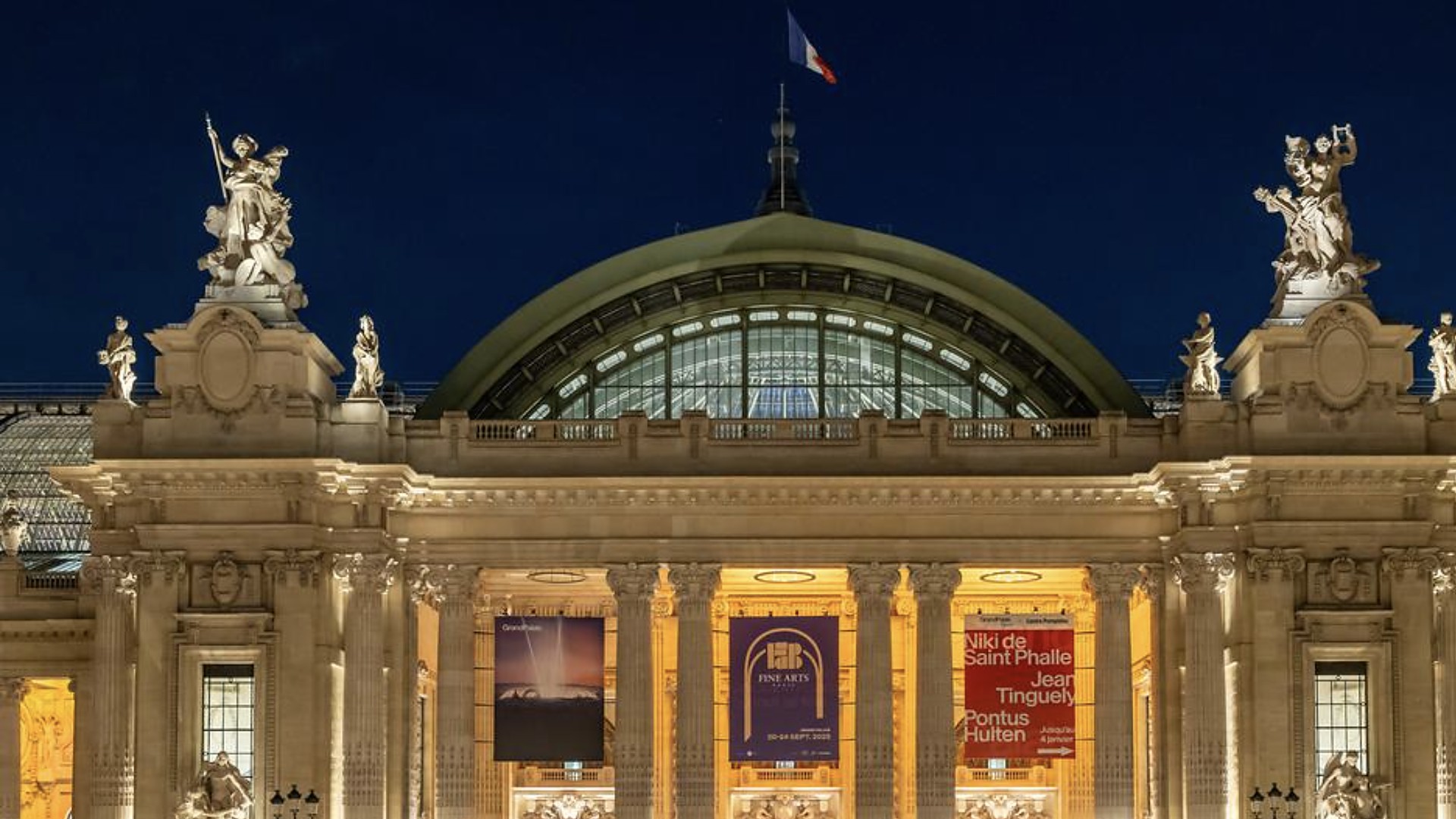
Photo: the Grand Palais during FAB Paris 2025. © Tanguy de Montesson / Fine Arts Paris.
Sources: Fine Arts Paris (official website, press kit of 24 August 2026, practical information), City of Paris, Grand Palais, Le Journal des Arts (2 October 2025), Musée d’Orsay. Consulted on 20 September 2026.